

A new approach to studying the birds for Costa Rica…

I took a different approach to study this time. I loved it AND it was very effective. When I was there I found I knew almost all of the bird names and recognized at the least the group/family a bird I spotted was in – which is very helpful. I did this because I figured the relaxed & easy tour would not be quite as relaxed or as easy as purported and I might be birding without a guide a fair bit. I was – but that is when this preparation really paid off…
Well then and -- My tour guide, who is the author of the 2017 “The Birds of Venezuela”, currently out of print, is working on an app for his people (who are currently economically challenged -particularly their once thriving Tourist industry) and has asked me if I would like to help because he loves the concept of these pieces & what I did before my first South Africa trip.
He’s been a bird guide for 40 years and says he has never seen a concept like this. He thinks it will resonate with his target audience - beginning birders, making the identification process easier & more visually appealing. I am honored and hope it works out - it would be a wonderful way to contribute to the wider birding community.
Of the 59 pages of bird groups I was able to get a photo of at least one for all but 4 pages. So instead of bunch them in with the other sets in the blog I am including them in this introductory post. I still aspire to see these birds...
Antpitta, Antvireo & Antwren++
These are forest floor birds and your best shot at seeing them is to find an Army Ant swarm. This swarm is a spectacular natural event where millions of nomadic ants march in relentless waves, with their movements creating a "moving carpet" that attracts numerous "ant-following birds" who feast on insects, spiders and small vertebrates fleeing from the onslaught.

Although these swarms are found all over Costa Rica, they are very unpredictable and it requires luck and good timing to see them. We did not. I heard & briefly saw only the Silvery-fronted Tapaculo when birding by the bus one day, but not long enough for a photo.
The same for the next two categories -- only saw and/or heard a few of them, but no photos. Next time I go I need to find a swarm!
Antbirds

Antshrikes & Antthrush

Foilage-gleaners +
These small brown birds are named for their habit of gleaning or picking (but gleaning sounds so much nicer) insects and arthropods from leaves and branches in the dense understory, They are often found in mixed-species flocks, but they are famously secretive and hard to identify due to similar appearances. I also included the Leaf-tosser, Treerunner & Tuftedcheek in this page. My group did see the Ruddy Treerunner on a walk I was not on.

We were always hopeful that we would come upon a mixed flock or tried to summon one in (usually using a Pygmy Owl call). We had a few small flocks, but not the volume we had hoped for.
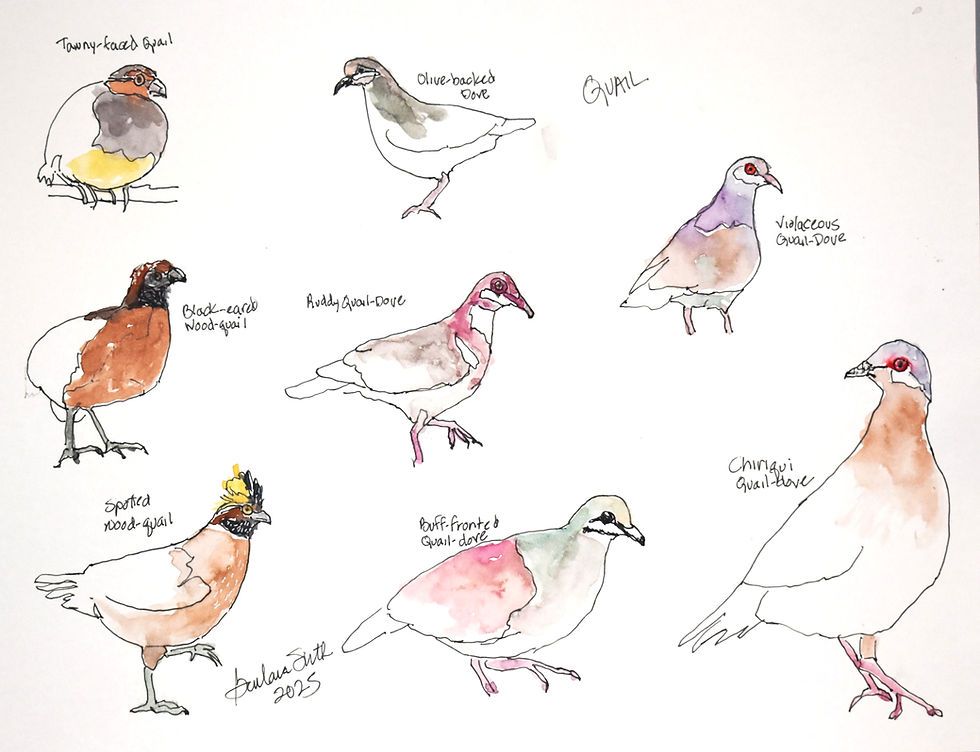
Quail
I was excited to see how many Quail species were expected in the parts of Costa Rica I was visiting, but I struck out. My group saw a partridge at one location (that was down a scary hill), but otherwise no quail. I have recently become fascinated with these lovely ground birds, so it was probably one of my biggest disappointments from a general wonderful trip.
I saved the biggest disappointment for last – this group of birds is tough to find and some of the species are endangered. Pat thought he spotted a Yellow-billed Cotinga from the deck at the Cerro Lodge, But it was very far away and through the scope – we ultimately decided not to “take” it.
Cotingas +

Although there were a few disappointments, in my mind its just another reason to go back again. So many more birds to see!


Comments