

Non-bird Creatures in Costa Rica

Although I didn’t visit Costa Rica for the non-bird creatures, they are always a bonus. I was a little concerned about the little creepy crawlers I might encounter, but they were few and manageable. So here are the creatures we managed to see –
Mammals
The iconic Costa Rica mammal would be the sloth – we saw both species – Three-toed and Two-toed but the Two-toed was from the boat on the second to last day and so tucked into the foliage it was impossible to get a decent photo. At our first stop in the Caribbean Lowlands, I left the walk a little early to sit at the feeders and was rewarded with a Three-toed Sloth climbing, fairly quickly, for a sloth, up a palm tree. I managed to get a short very back-lit video (will post later) and was happy it stayed perched in the tree until the group returned.
Brown-throated Three-toed Sloth


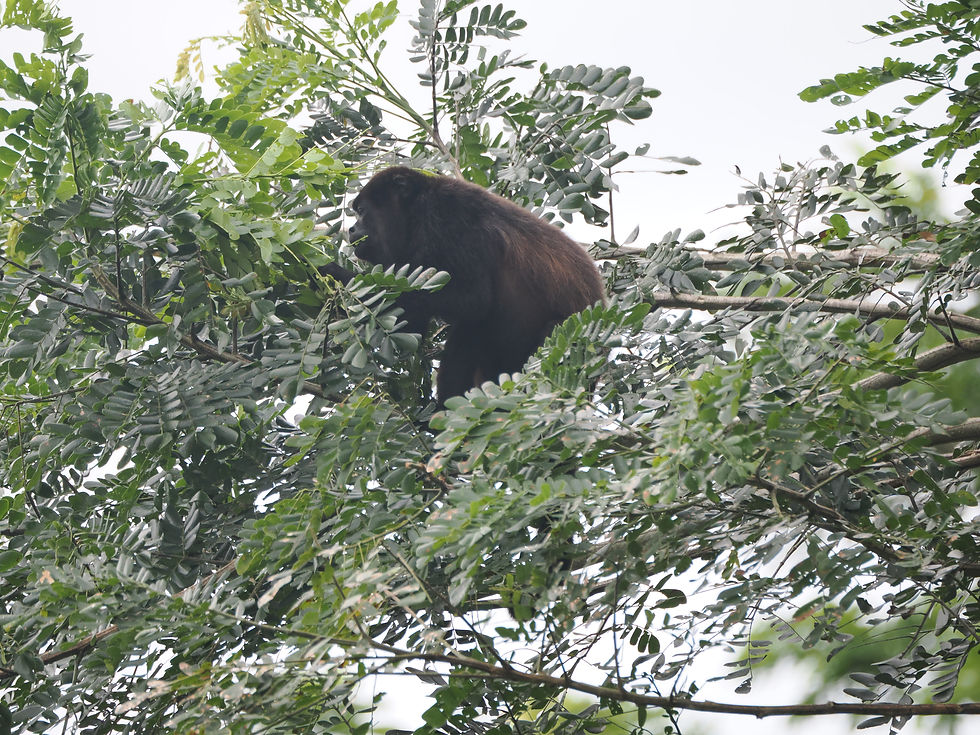
I had monkeys in both parts of the trip, but not the elusive Spider Monkeys. At the Cerro Lodge both species were present near the deck, but only the Capuchin visited the feeders. They are charming, but quiet. The Howler monkeys are aptly named as the make quite the caterwaul when they are vocal. I think it could wake the dead
Capuchin Monkey


Howler Monkey




Don’t remember any squirrels down near the coast, but we had several on the Tour. Both near the Central Valley.
Variegated Squirrel

Red-tailed Squirrel

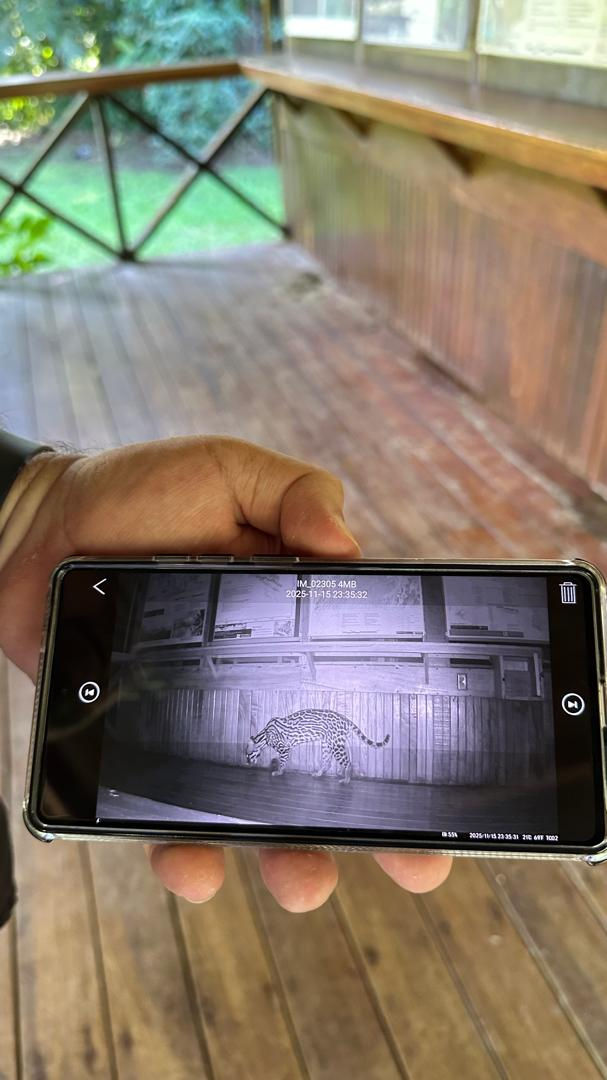
On the Le Salva Research Station we ran into a few guides while waiting for the rest of our group to cross over the hanging bridge near a small building. Birder’s know that a bird ID can be heard only, well, we had a “smelled only” ID of an Ocelot near the far end of the hanging bridge.
Ocelot
The source of the smell -- The Ocelot marked with both poop and urine

A photo of the previous night's Ocelot's visit.
In the same beautiful spot we had a herd – some 25 pigs -- of Peccary (usually called Havalina in Arizona) including some tiny ones.
Collared Peccary


We had several Coatimundi at the base of the Aerial Tram. This creature is kind of like a softer Raccoon.
Coatimundi

We saw an Agouti on the Cerro Lodge entrance road, much to Pat’s surprise and had a quick look at another one on the tour – sorry no photo.
Then we saw a variety of bats – all in the daytime!
At our first stop in the Caribbean Lowlands - Pierella Ecological Garden, on our walk the guide kept telling us to avoid touching a leaf that was hanging over the trail – it’s because this was hiding underneath…
Honduran White Tent-making Bat - Photos courtesy of David Ascanio


I had this bat (who we can’t exactly identify) attached to my window screen in the bathroom shower. I tried to get a shot from the outside, but it was too dark.

Somehow on our final boat trip, the captain spotted these bats roosting on a tree. This is not my photo, because I could not find them in the lens. They give the term camouflage a new meaning!
Proboscis Bats - Photo courtesy of David Ascanio

Reptiles
It makes sense that a very humid country would have lots of reptiles and Costa Rica does not disappoint. I don’t think we saw as many as we could have if we were actually looking for them. I was a little surprised we only saw one snake.
My favorite of the reptiles were the Basilisks (and the Basilisk Lizard) The first one, Pat thought was an Owl – so we jumped out of the car. Normally missing an Owl would disappoint me, but a Basilisk!
I wouldn’t even know what a Basilisk was if it wasn’t for Harry Potter – these creatures were a lot less scary.
Black Basilisk


Green Basilisk


The Common Basilisk is also known as the Jesus Christ Lizard because it walks on water.
Common Basilisk

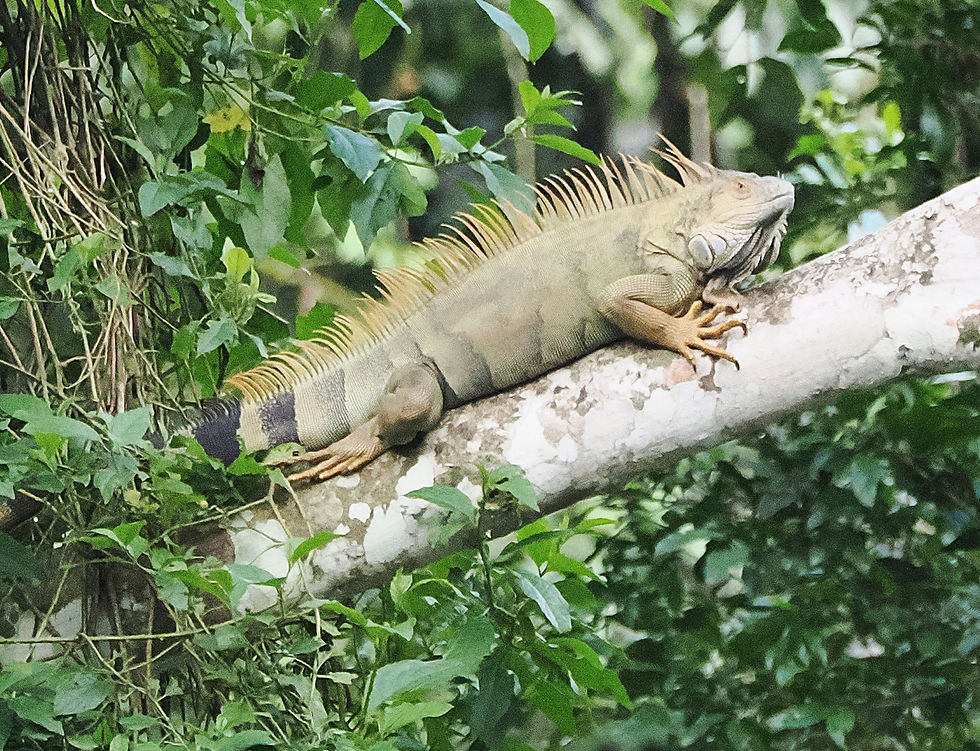
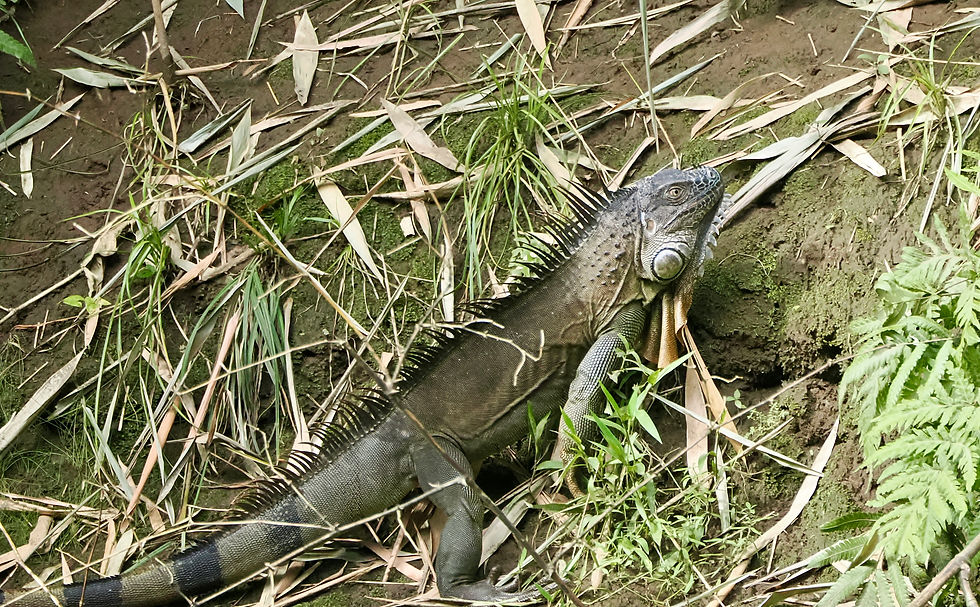
Iguanas were all over the place and boy were they BIG, Black ones on the Coast and Green ones elsewhere.
Black Iguana


Green Iguana




We had several American Crocodiles on the Tarcoles River Boat trip – none in the water, all basking on the shore.
American Crocodile


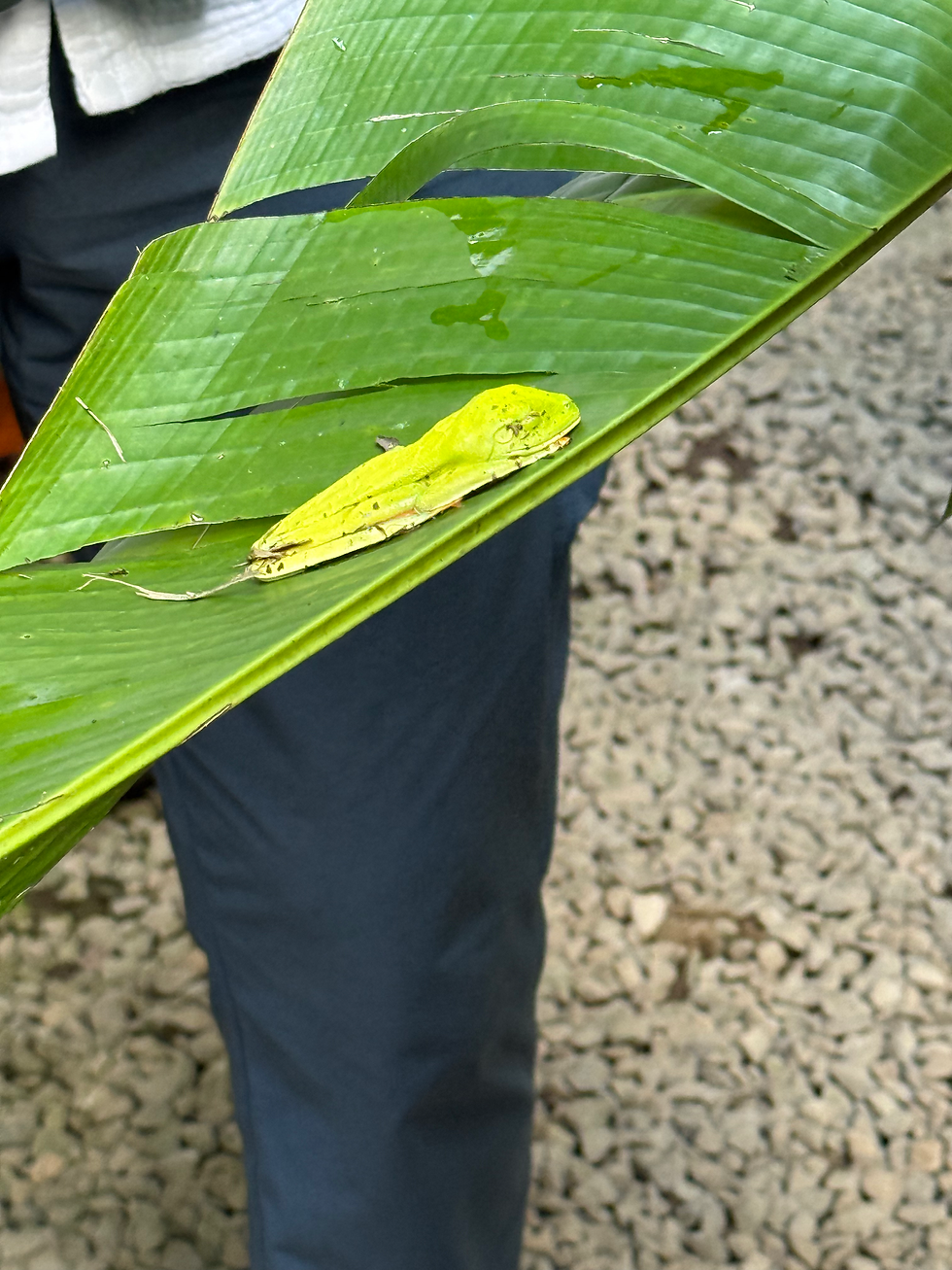
Only one sleeping visit with the Iconic Costa Rican Red-eyed Tree Frog (to be clear the frog was sleeping, not me). Looked so different I didn’t realize it was that iconic frog until I told David I was surprised we didn’t see one – but we did.
Red-eyed Tree Frog


Only one species of Turtle was a little surprising as well. Although we saw this species twice – from the hanging bridge in La Selva (remember the motion made it impossible to take photos) and on the boat trip in the Caribbean Lowlands.
Black River Turtle


At lunch one day on the coast I spotted this lizard on a tree just off the seating area. I think it’s pretty…
Yellow-headed Gecko


This little guy gave me a little show off the trails at La Selva when I was sitting alone on the trail. Sometimes I get treasures like that.
Central American Whiptail

Finally – the only snake we saw was at the top of the Aerial Tram – he was pretty tiny, but I am told his mandible is capably of expanding to ingest small lizards.
Cope's Vine Snake


David's snake encounter
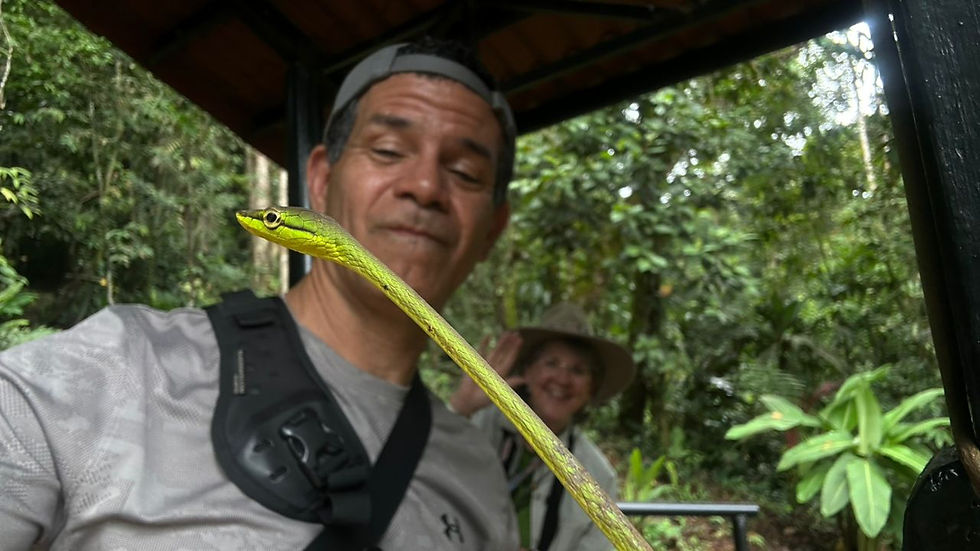
The snake getting ready to hit the panic button for the tram...

Bugs
Don’t stop reading because I include Butterflies in this and the one creepy-crawly is pretty cool.
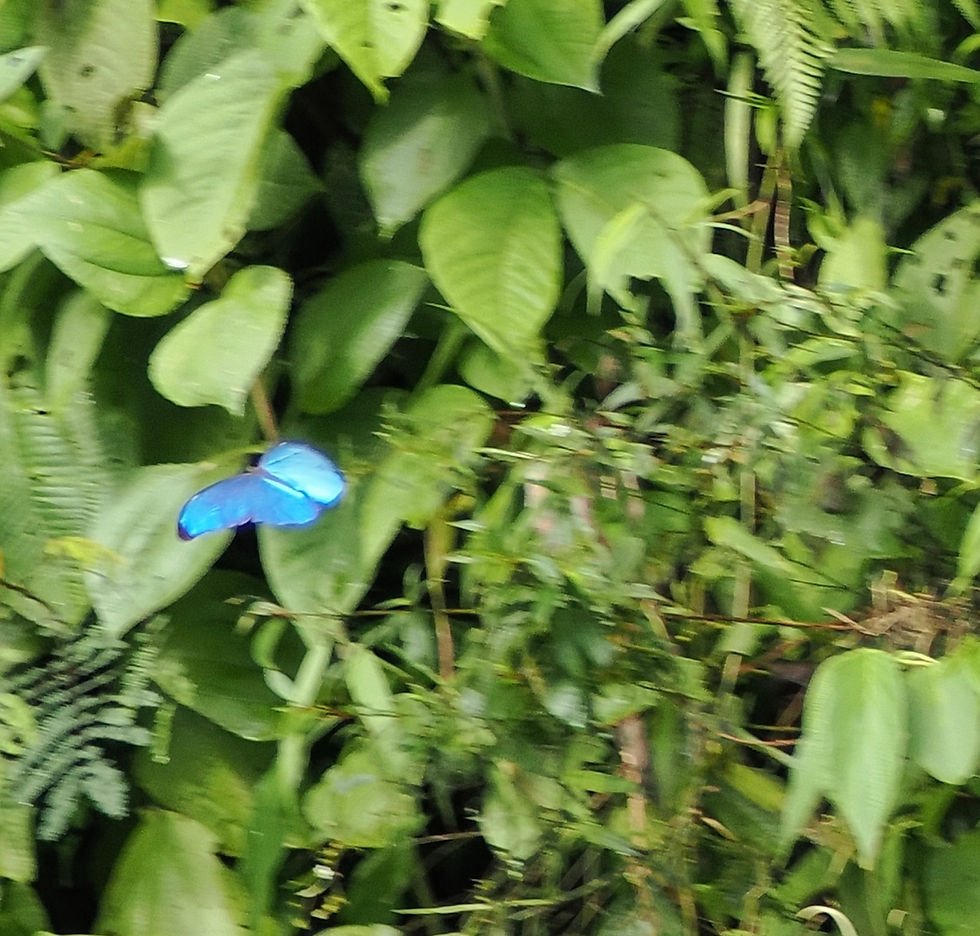
I had a number of encounters with the Blue Morpho Butterfly which is pretty large for a butterfly - @4.7 inches. The back of its wings are brown, so it looks quite non-descript and boring when it’s wings are not spread. When it spreads its wings it is a magnificent iridescent blue. It flies quickly and in a kind of arcing manner so it is quite difficult to even get a decent photo. On the day the highway was closed near the tram, I was finally able to capture it.
Blue Morpho


This gorgeous creature is a Glasswing Butterfly taken by one of my tour mates – Kimberly. She only uses an iPhone and I am quite impressed with what she captures with it. I appreciate that she let me share this.
Glasswing Butterfly - photos courtsey of Kimberly Higgins


This spider was spotted on a bench on the tram, just as I was about to put my hand on it. I am grateful to the guide who stopped me before I made contact. It is a Wandering Wolf Spider, who doesn’t weave a web, but actually hunts its food. That body part that looks like a blueberry is actually an egg sac which contains about 200 eggs. When they hatch, they will climb aboard Mom and travel around with her for several weeks until they are large enough to hunt and survive on their own. Amazing creature
Wandering Wolf Spider


More photos courtesy of Kimberly Higgins


I hate to end on a negative note, but the disappointment on the non-bird creature side was missing the Baird’s Tapir. I’m told it is not the easiest creature to see, although there are Tapir crossing signs everywhere – I’m guessing it is not all the common to see them crossing the road. Again – another reason to return to beautiful Costa Rica.


Comments