

Big Birds in Amazonia
- Barbara Seith

- Jun 6
- 7 min read
Too many birds for one post -- that's a good things. Lots of looking to the canopy and to the skies -- the raptors there were magnificent. More Kites than I have ever seen.
Raptors - Falcons, Caracara, Hawks, Kites and Vultures crowd the skies -- we even had a mixed kettle that I'm sure had more than 100 birds in it.

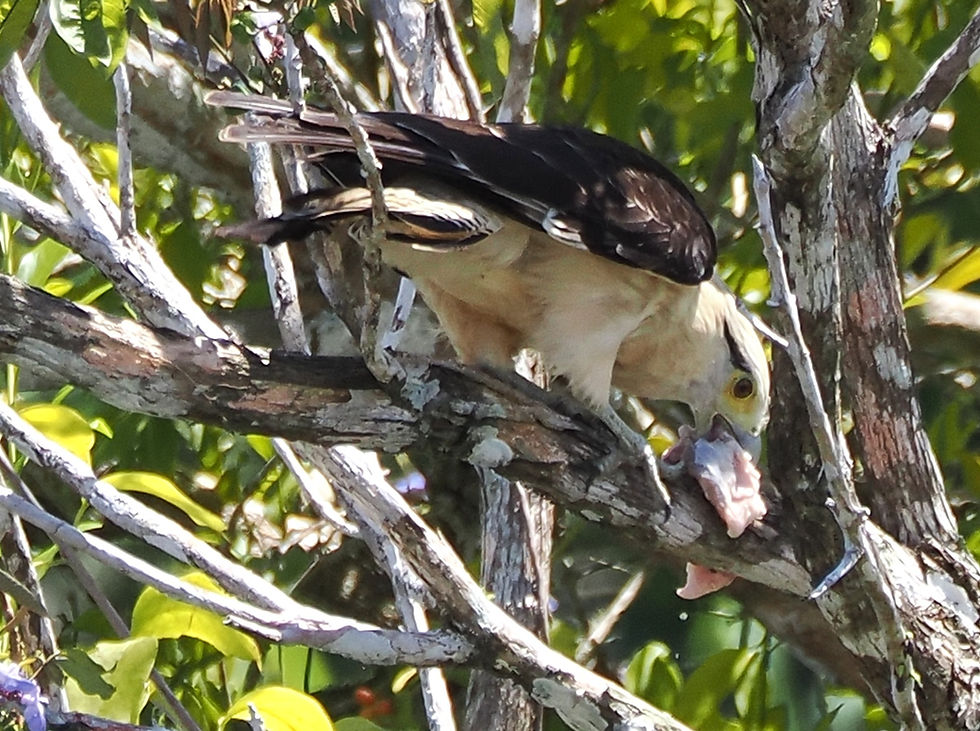
The Yellow-headed Caracara was the most plentiful Raptor -- we saw multiple daily. Its a beautiful creamy colored bird with intense eyes and lots of personality.


Juvenile


This one was actually fishing or at least fishing something out of the water -- Mo said it looks like pork... I said where would they get pork in the river... someone tossed something over the side.
The dramatic (mostly - except for those awesome Red parts) Black Caracara didn't show up until one day late in the trip -- luckily they were cooperative.


We also saw two other Caracara - Crested & Red-throated, but alas no good photo opportunities.
Not a new bird for me, but we did have some quality time with a few Bat Falcons


The Hawks were superstars, showing up all over the place. The Roadside Hawk was ubiquitous and always made me stop and think -- is that something new? It usually wasn't.
I got to see the Roadside Hawks (or as we called them on the boat Riverside Hawks) from almost every angle.

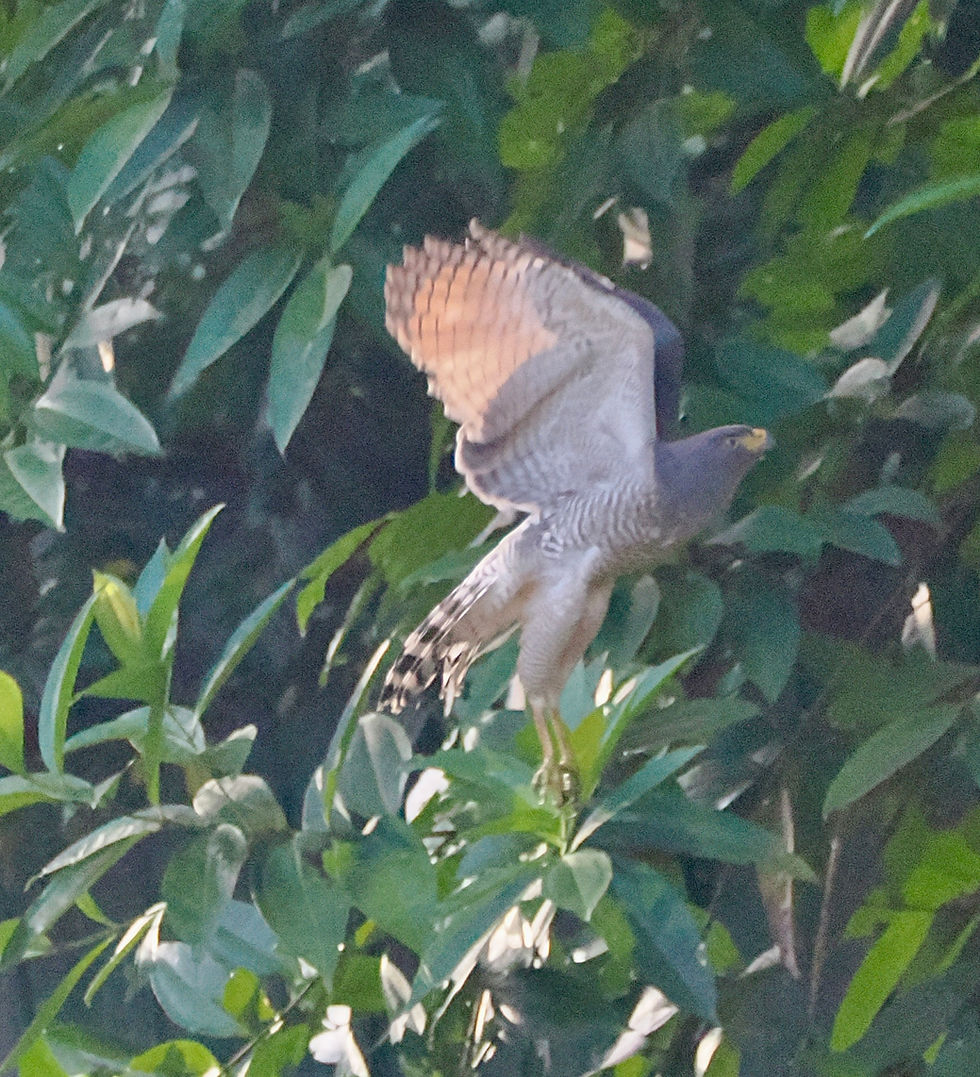


Black-collared Hawks were a new and coveted bird for me. I love the color of their breasts and felt their intensity in every encounter -- we had a lot of them. They were around most of the trip.


The Great Black Hawk, another life bird, was harder to get a good shot of. I've included some not so great shots as proof... this is not an easy bird to capture on a photo.

The leaves were very uncooperative

A little out of focus -- but at least its the whole bird

Not bad, but extremely far away!

This Gray-lined Hawk was a life bird in very tough light


The "best" Hawk we had on the trip waited until the second to last day -- and we had a whole family. The joke was "What kind of Hawk is that?" "It's a Tiny Hawk." "I can see that but what's its name?". Anyone for Who's on First?
Only 7-10 inches high, it really is a Tiny Hawk.


Vultures were fairly plentiful as well. The only one I did not get a photo of was the Turkey Vulture -- they do look a bit different from the ones we have in Rhode Island, but I'm not weeping about the miss. Happy to see a few new species.
Lesser Yellow-headed Vulture -- this species was only second to the Black Vultures, which really rule the roost in this region.

King Vulture -- is really spectacular close up, unfortunately this is a pretty typical distant.

Black Vultures -- playing around on a Satellite Dish. All over the place!

Greater Yellow-headed Vulture - both Yellow-headed were life birds

Although the skies provided lots of beauty and grandeur, my favorites were the Kites. We only rarely see them in Rhode Island and until my April trip to Florida, my nemesis bird was a Swallow-tailed Kite. I had a nice visit with a few on the Anhinga trail in the Everglades. But lucky me I got to see them again on this trip.
Still this was the only decent shot I got of the Swallow-tailed Kite with a Plumbeous Kite below.

Plumbeous Kite -- this bird has lovely Orangey wingtips but its name means "resembling lead, containing lead, or having the dull, heavy, dark-gray color of lead". Whatever the name it's a beautiful bird.


Hooked-billed Kite is similar to the Plumbeous, but less Orange in the wing tips.

Early in the trip we happened into a colony of Snail Kite nests -- we were told it was previously unknown. We had a wonderful visit with the @35 birds in different ages and plumages. Spectacular!


The bird on the bottom is actually a Black-collared Hawk interloper -- who was dispatched quickly.

Juvenile

Sitting on a nest -- always exciting!

Juvenile


Another occupied nest

This life bird waiting until the last day to show up. This vocalizing Slender-billed Kite was perched in a tree above a swamp, but was soon joined by the rest of its family in flight.


This next section has waterbirds and waders - you'd think since we were on a big river, all the birds would be such, although there are a fair number of them, they are only one component of the bird life in this biodiverse place.
I'll call this first group - not Herons, they are mostly one offs in a group or family.
Black-bellied Whistling-ducks did a flyover at our first stop

This Purple Gallinule chick came out to see us just before we entered the floating forest

Green Ibis showed up through out the trip, but always seems to arrive in gloomy light


On a walk through a neighborhood in Manaus before we boarded the boat we can into this Gray-cowled Wood-rail, a familiar species from Costa Rica, but it decided to be a dare devil and cross the road to beat the on-coming motorbike!


Southern Lapwings were seen several times during the trip, but always rather far away. I am quite fond of their square tail extension.


My best shot of this life bird - a Wattled Jacana - was the first one from the big boat.


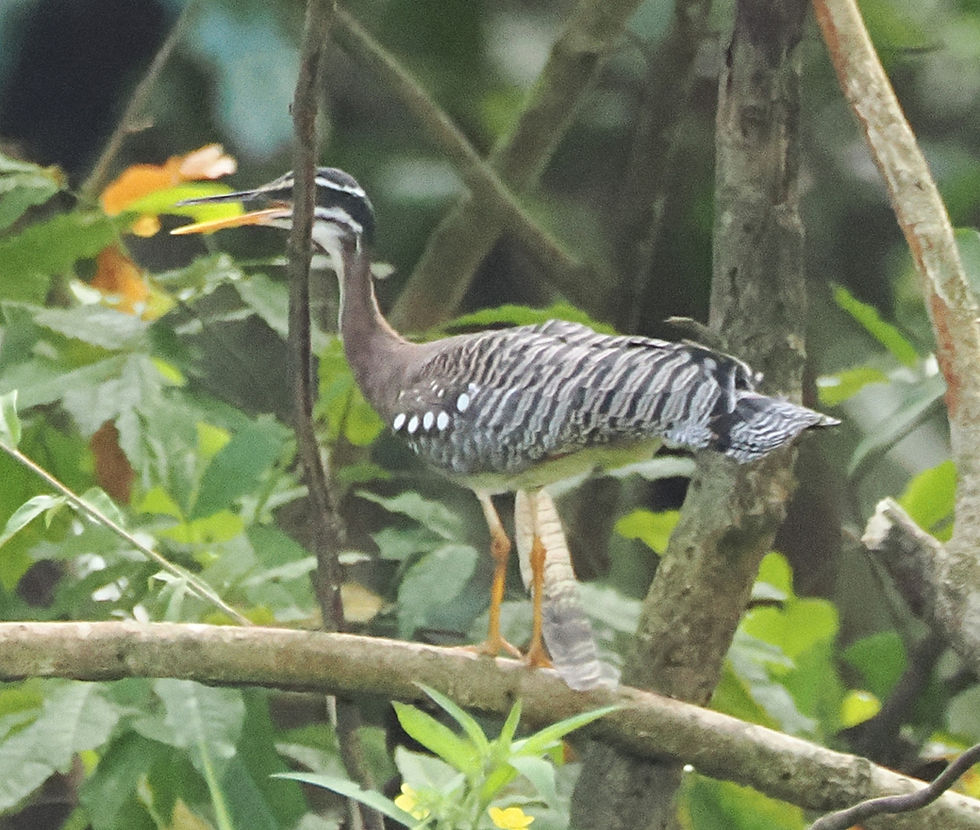
This groups can be described as Waders or even Herons and allies, which includes one of my favorite birds of the trip, the Sunbittern, even though it was not a life bird, I had a better visit with it here than in Costa Rica.
Great Egrets abound


Some Snowy Egrets too

And a good number of Western Cattle Egrets

Since I only study potential life birds for the trip -- I did not realize one of my favorite birds, a Limpkin, would be present as well.

A lifer, Rufescent Tiger-Heron -- much bigger than I thought they would be.


Striated Heron -- another life bird


My one and only Cocoi Heron -- very close kin to our Great Blue Heron

Capped Heron -- what a color on the bill!


Sunbittern, whose best feature is only shown when it flies. It has a gorgeous intricate pattern on the back of its wings -- unfortunately I was not prepared the two times it flew. Note, it looks like it is losing a feather.



We had a number of Oropendola sightings, they are not always easy to tell apart when backlit, but we managed. I did not get a shot of the Green Oropendola and some of my Olive photos are not great, but good enough to identify. They are cool treetop and snag birds.
These Russet-backed Oropendola showed up early in the trip.


The yellow tail is the key feature to identify this Olive Oropendola.


The Crested Oropendola is the only one with a single colored bill.

This large pigeon was easily mistaken for a raptor when back lit -- It's a Pale-vented Pigeon.

Sometimes Pigeons can be beautiful -- this is one of my favorites -- Scaled Pigeon.

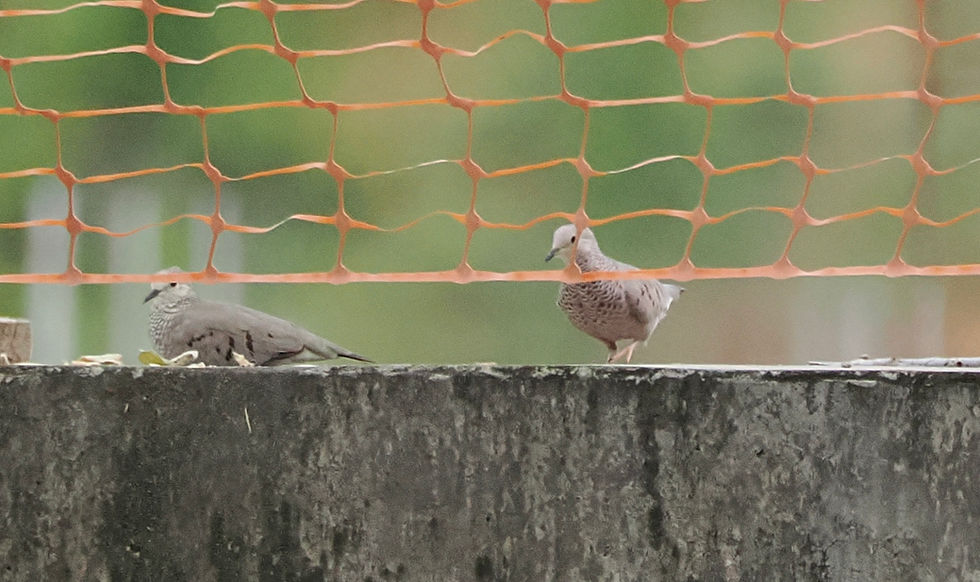
This is a borderline large bird, the Common Ground Dove is a fairly small Dove, but it seemed to belong with the Pigeons. This was in a construction area near the hotel.
Was excited to cross some Ani's off of my needs list. The Greater Ani became one of my favorite birds of the trip. Its almost crow sized and since there are no crows in the region, it was my go to black bird.


It was very wet the night before -- I can't blame it for fanning out.


In the sunlight, they do not look so black...
Some great birds usually only come out at night, but I was lucky -- a day time Owl and Potoo, plus some good activity at sunset.
I spotted this Tropical Screech-Owl in our first flooded forest foray. Also saw three of them come out from what I assumed was a nesting cavity, but may have been a daytime roost.


Since I wasn't planning on going on any night excursions, I had resigned myself to not seeing a Potoo. It was almost dark as we headed back from the Enchanted Lake and one of the guides spotted this Great Potoo in a tree. Close and cooperative - SCORE!


On our last day, we happened upon this Great Potoo resting in a tree. I consider myself extremely fortunate to have seen at least two of these beautiful unusual creatures.

Band-tailed Nighthawks were tough to photograph, but not difficult to see -- they are very fast, so one has to be lucky to capture one. I probably saw @70 of them and only got two photographs.


This last groups are what I call the Tropical birds -- Toucans, Trogons, Hoatzin, Screamer and more. They pretty much define Amazonia for me.
This Amazonian Umbrella bird was with a female and his umbrella is up -- that craggy crest is what's call the umbrella.

This bird has a blue wattle on its neck, but is name a Bare-necked Fruit-crow. It's large and other than the wattle, pretty subtly colored.

This is the only Chachalaca that I saw -- in the magic fig tree near the hotel. I think they look like chickens.
Variable Chachalaca


Several different Caciques populate this area, but the Yellow-rumped Cacique seen below is the most common.

Cacique Nests - woven and hanging from trees

Horned Screamers were a coveted find at the beginning of the trip and we only saw them once (although there were three of them). Mika, the captain came up to the deck to tell us they were out there, then they came closer. They are BIG! Yes we heard them scream!


Note the slender ivory colored horn coming out of its head


One of my favorite new birds and good thing because we saw a LOT of them. Hoatzin - pronounced Watson, owns a lot of the trees above the river -- we every managed to see young birds.


Juvenile


We saw more than two Trogon species, but they proved experts at hiding behind branches and foliage.
Green-backed Trogon was one we saw frequently.


This Guianan Violaceous Trogon was one of the two Violaceous Trogons (the other one was Amazonia) we spotted.


The morning and sunset are generally owned by the Macaws flying in and out of their roosts. The most common were these Blue-and-yellow Macaws -- chacterized by racous vocalizations and very long tails.
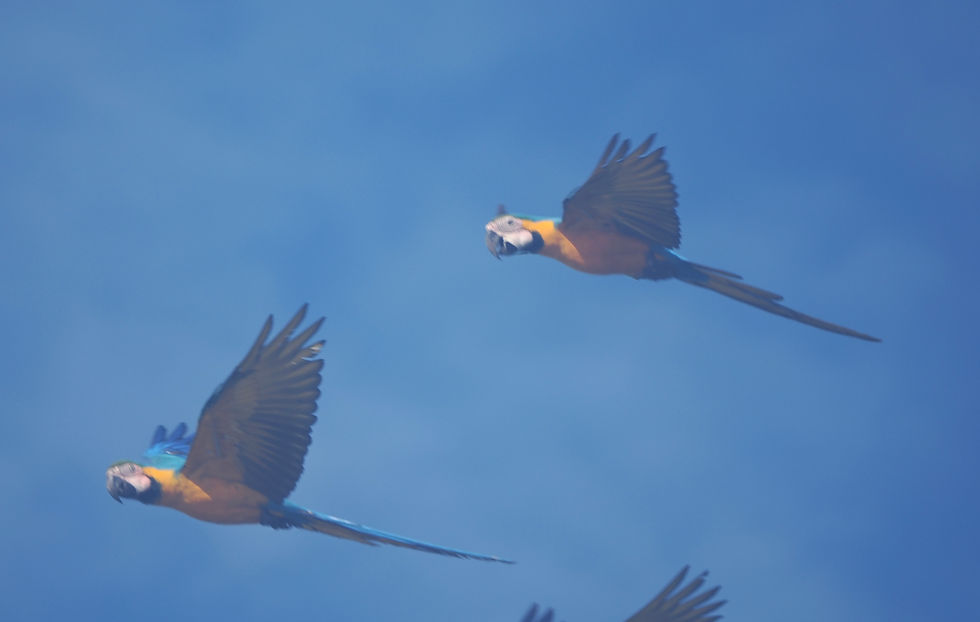


We also saw Red-and-green Macaws and
Chestnut-fronted Macaws

and Scarlet Macaws

Another spectacular tropical species is the Aracari. They are often associated with Toucans, but are more compact and have serrated bills.
Chestnut-eared Aracari


Black-necked Aracari

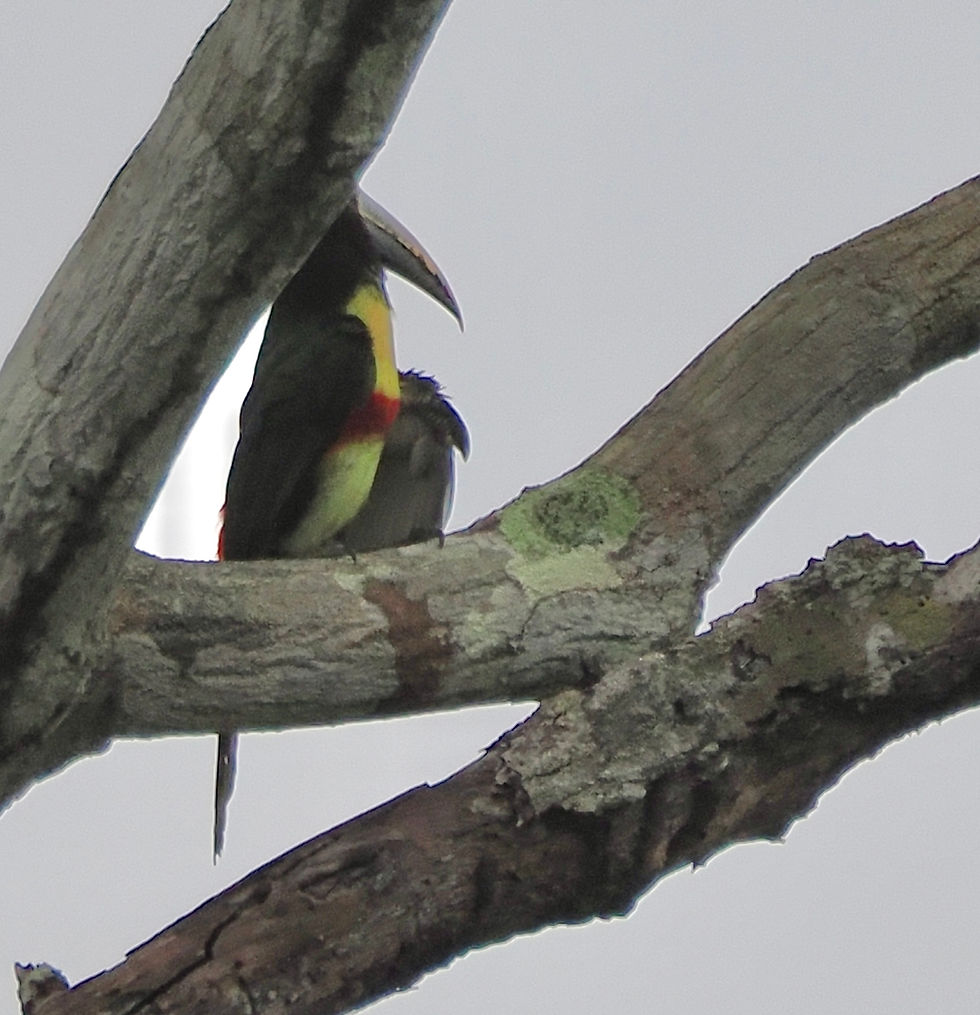


The biggest tropical bird is the Toucan -- we saw two species on a regular basis
White-throated Toucan


Channel-billed Toucan


Parrots and Amazons (which used to be called Parrots) are the medium sized colorful birds.
Dusky Parrot


Red-fan Parrot


Blue-headed Parrot
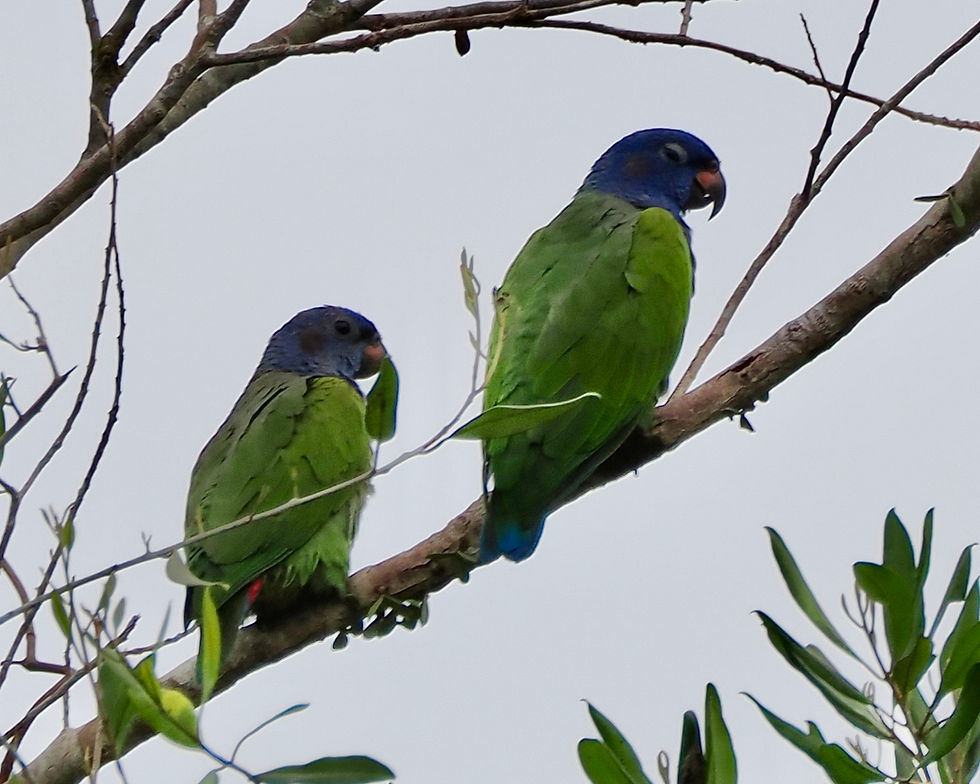

Cacia Parrot

Orange-winged Amazon

Festive Amazon


This White-winged Parakeet was the first exotic I saw from my hotel window (on the 9th floor)


Tui Parakeet


Brown-throated Parakeet

That's the larger birds -- but there's more -- look for the Smaller birds post.


Comments