

Smaller Birds in Amazonia
- Barbara Seith

- Jun 5
- 4 min read
Did I mention how biodiverse this area is -- it seems to me the more biodiverse, the more small birds. This area was not an exception. Again I organized them in loose groups, so please forgive any scientific anomolies.
There are no Gulls in Amazonia -- none - nada - zilch. So odd for me who spent this morning with hundreds of Gulls and a few terns. They do have terns but not the ones from Rhode Island. There are typically only two species.
Large-billed Terns

Some pre-sunrise shots


Those are BIG bills!


We had a few Yellow-billed Terns too -- so much more dainty

We had great luck with Cotingas --
Spangled Cotinga


Pompodor Cotinga


Like Rhode Island Amazonia has Woodpecker, but they have a LOT more and different ones.
The one we saw the most of was the stunning Ringed Woodpecker.


The White-throated Woodpecker

Yellow-throated Woodpecker

Golden-throated Woodpecker

Lineated Woodpecker (truth be told, this is a big bird)

Yellow-tufted Woodpecker


Spot-breasted Woodpecker


Woodcreepers look like Woodpeckers, but they do not peck, they just feed on bugs that are on top of the tree bark. We don't have them in the north east US -- not enough bugs on top.
Striped Woodcreeper


Straight-billed Woodcreeper


Long-billed Woodcreeper


Olivaceous Woodcreeper

Buff-throated

Unlike South Africa where many of the Kingfishers are woodland birds, Amazonia's Kingfishers are all aquatic.
The Ringed Kingfisher looks the most like our Belted Kingfisher -- it is also the largest.

The smallest one we saw was the Amazon Kingfisher

The only life bird Kingfisher was the Rufous and Green -- thanks to Costa Rica.


The lovely Green-kingfisher!

Like most tropical regions Tanagers and allies are replete. The first two here are seen constantly.
Blue-Gray Tanager


Palm Tanager


One morning we came upon a "Magic" tree that was full of Tanagers and the like.
Blue Dacnis (male & female), Purple Honeycreeper


Blue Dacnis


Purple Honeycreeper


Spotted Tanager

Yellow-bellied Dacnis


Golden-bellied Euphonia


Golden-sided Euphonia

Besides the large raptors, the skies are also filled with Martins, Swifts and Swallows -- all notoriously difficult to photograph in flight -- you have to get them when they perch.
Brown-chested Martin


Gray-chested Martin

Southern Rough-winged Swallow

White-winged Swallows


Pretending to be a hood ornament


There are more Flycatcher and allies species in Amazonia than anything else -- and they look a lot alike. I've figured some of them out, but still see the occasional Tropical Kingbird and think -- huh that looks different. At a certain point, Luke refused to continue to ID them. I can't really blame him, there were soooooooo many!
Althought it's a little blurry it was my first Life bird on the trip (taking from my 9th floor hotel room window) but it is the only one that shows the tail extended. We saw quite a number of this magnificent species - Fork-tailed Flycatcher - on the trip.


Rusty-margined Flycatcher


Social Flycatcher


Streaked Flycatcher


Three-striped Flycatcher (easily confused with the Yellow-throated Flycatcher)

Sulphury Flycatcher

Variegated Flycatcher


Yellow-throated Flycatcher


The ubiquitious Tropical Kingbird (not a life bird -- I got my first one in - of all places - Rhode Island)


White-throated Kingbird -- just slightly less prolific than the Tropical Kingbird and it's a life bird.


Great Kiskadee

Amazonian Black Tyrant -- very vocal and stealthy in the flooded forest.

Olive-faced Flatbill (look closely on the left side)

Elaenia are tiny and diverse -- so small its a tough ID. We also saw Forest & Yellow-crowned as well as these two.
Small-billed Elaenia

Yellow-bellied Elaenia


There are many Hummingbird (often by another name) in the Region, but there are no feeders and because the water was still high, less flowers that expected at this time of year. Hence, less Hummingbirds and the ones that were there were on the move and tough to photograph and identify.
Long-billed Hermit


Striped Hermit

Green-tailed Goldenthroat


Three elusive Hummies


White-necked Jacobin

Although there are not a diverse population of Finches/Seedeaters/Sparrows, the ones they have there are quite striking.
Jacamar are in my opinion a Hummingbird in a bigger body with a Kingfisher bill. What's your opinion?
Yellow-billed Jacamar

Green-tailed Jacamar

Paradise Jacamar


Bronzy Jacamar


Would have loved to see more Manakins, but if I had to choose only one, this would be it.
Wire-tailed Manakin


My first Finch turns out to be a Saffron Finch, which is indicated as rare at the hotel, however, there appear to be plenty of sightings and nothing currently on eBird indicating approval is pending.


We saw the Orange-fronted Yellow-finch all along the trip - a lovely bird.


This is from the first walk of the trip - Cinnamon-bellied Seedeater


Only two of us saw this bird, as we stayed back from the trip to see the Night Monkeys and the Tarantula -- this was our reward.
Cinnamon-bellied Seed-finch


Yellow-browed Sparrow was the only Sparrow I was expecting.


This House Sparrow was spotted and photographed by Catherine Hamilton -- the first reported House Sparrow reported in Jau National Park! Who knew?

This next group is a mixed bag with only one or two related species.
Orange-backed Troupial - in multiple places.


Bananaquit

Southern House Wren

Black-capped Donacobius


Masked Tityra


Black-tailed Tityra


Rufous-breasted Peppershrike -- we heard it long before we saw it!


Black-billed Thrush


Bluish-gray Saltator


Red-capped Cardinal


Red-and-white Spinetail


Nunbirds & Puffbirds were all new to me -- The Swallow-winged Puffbirds seemed almost as numerous as the Tropical Kingbirds.
Swallow-winged Puffbird


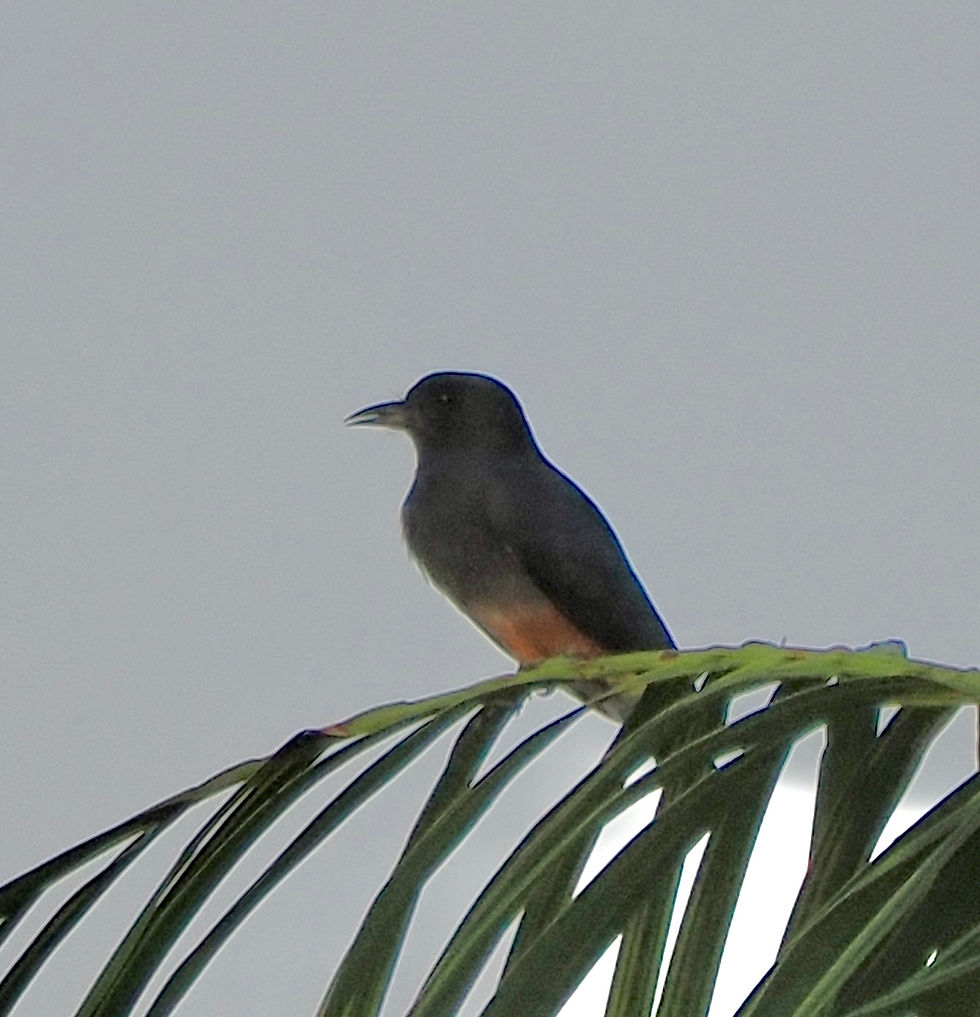


Pied Puffbird


Black-fronted Nunbird


Antbirds, Antshrikes and Antwrens are another tough bird to photograph -- always amid the sticks. Still I got a few shots.
Black-crested Antshrike

Leaden Wren from the rear

Klages's Antwren

Barred Antshrike


So that's the birds -- 286 species, 209 life birds
Largest numbers:
465 Black Vulture
258 Large-billed Terns
203 Tropical Kingbird
Once in a lifetime - fun time - great birds - great company!


Comments