

South Africa - Day 13, Lower Sabie

First I forgot to write two things about previously -- so I'm just going to start of with them. I guess I was tired when I wrote it last night, my apologies.
I can't believe I forgot to tell you that I hung on to that Shotgun seat. It was easier to sit for me and Vince, who would normally sit there when he is in the car, was happy to get a view from the "client's" seat. This was like heaven for me. I had the same position I normally have when car birding in Rhode Island, so it is natural and easy. It isn't the perfect seat -- and some views are blocked, but the ease and comfort it provides me overwhelmingly counteract that. In addition, I get to watch Andrew and how he watches the landscape. Often that has allowed me to see the bird sooner, because I see him see it. I can't discount that fact that he is charming and funny company makes it more of a joy to sit here. The fact that my injury led to this position for the next four days reinforces my belief that everything happens for a reason.
The second thing is I missed telling you about the BEST animal we saw on the night drive. A South African Porcupine - its quills were all puffed out when the light first hit it. They flattened after a bit, but still the coolest find of the night (of course Vince found it) and Vince had never seen one at night before. Two reasons for it to be cool. Turns out that night Andrew was sitting on his porch that night and he had a porcupine visit too. Which prompted this discussion about how to cook a porcupine.
Andrew on the left, Vince on the right making bird sounds and the birds are contributing as well. I love and miss this cacophony.
Here was the route for the day

Again animals first
Baboon


Cape Bushbuck


Crocodiles

Dead Tree Creature

Savanna Elephant

This guy was trying to climb up the hill and was going to fall backwards, so he just dropped.


Giraffe


Hippopotamus


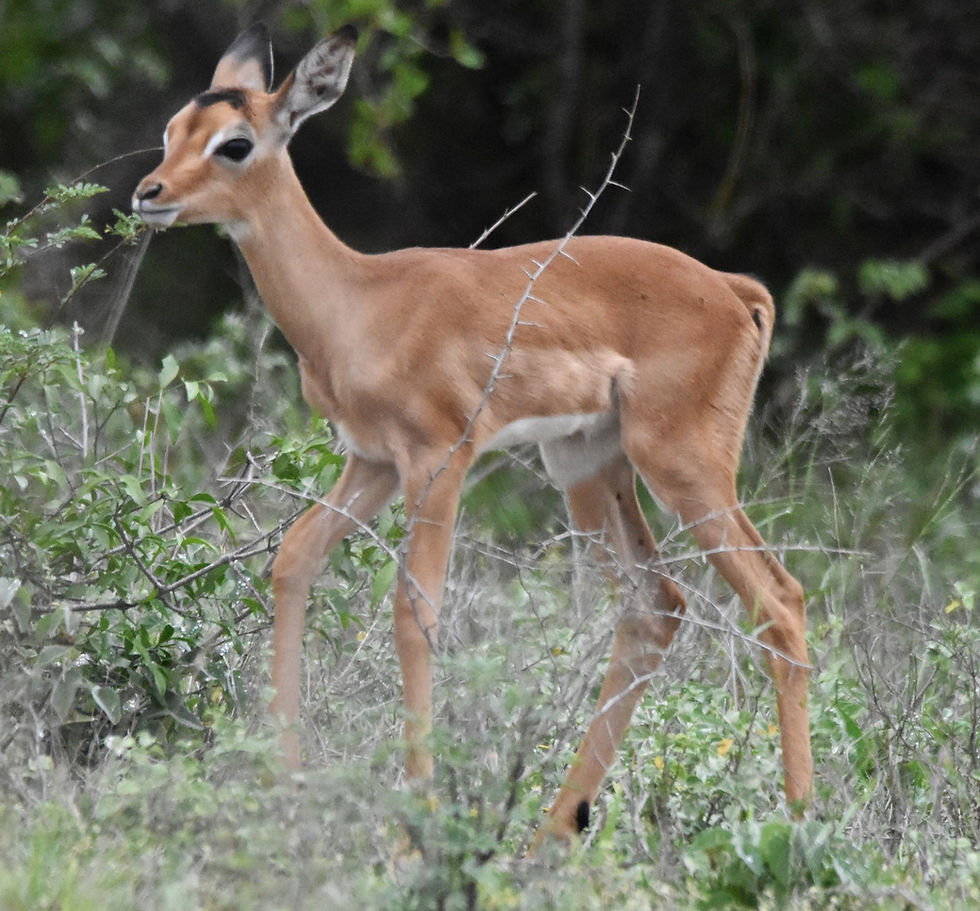
Baby Impala (Andrew estimate 1-2 days old)


Vervet Monkey and baby


Water Monitor


Rock Monitor


Marsh Terrapin

This bale of terrapin spurred a discussion of Turtles, Tortoise & Terrapins. I knew the difference between Tortoise - a land animal and a Turtle - a water animal, but I honestly had no idea what distinguished a Terrapin. Andrew enlightened me -- Turtles are marine/salt water animals leaving the water only to lay eggs and Terrapins are semi-aquatic/fresh water animals they spend time sunning on land and burrowing in the mud. He's baffled by the fact that most American's he meets just think they are all turtles. Just for that he gets another photo...

For the birds I'm going to write this post a little differently and group the birds a little. You've seen a lot of birds -- this might help you understand them more.
That was a target bird for the day a fairly rare find whose closest relative is a Coot. They are pretty secretive and not seen very often. Eagle-eye Mary spotted and it made Vince happy.
African Finfoot


The second find of the day had been Andrew's bird nemesis of late. Diamond Dave spotted a male, then the female was spotted as well. That made Andrew's day. The female of this species is more brightly colored than the male. We had more views of the male, but they were long and we got to observe their behavior. I did not have a good shot, so Andrew took these photos for me.
Greater Painted-Snipe (Photo credit - Andrew Wagner)


Female on the right, Male on the left

Female with bill tucked


We had lots of Storks along this route. Storks are large wading birds that stand up to 3.5 feet tall and have a wingspan of up to 5 feet. They have long slender legs and long sharp, stout bills that are bright in color.
Yellow-billed Stork


Wooly-necked Stork


Juvenile Saddle-billed Stork

Great Egret, Little Egret & Saddle-billed Stork

Black Stork


African Openbill is a kind of stork, but had a thin bill that doesn't close entirely.


African Spoonbill - not a Stork more directly related to an Ibis, but hangs out with Storks.


Lots of Eagles, Vultures & Kites - it seemed like every few minutes we were looking to the sky.
African Fish-eagle (Juvenile)

African Harrier Hawk

Black-winged Kite


Wahlberg's Eagle


White-backed Vulture


Tawny Eagle

Nest to the field, bush and tree birds. We were in a different habitat -- more treed less Savannah, so new birds abounded.
African Green Pigeon

Black-backed Puffback

Brown-crowned Tchagra


Collared Sunbird

Common Myna -- the European Starling of Kruger (Andrew is not fond of this bird)

Crested Bulbul

Dark-capped Bulbul

Dideric Cuckoo


Eastern-Paradise Whyda


Greater Blue-eared Starling in nest


Green-winged Pytilia


Jameson's Firefinch

Lesser Striped Swallow


Mocking Cliff Chat - Male Left, Female Right (Laughing Dove in the middle)


The Mocking-Cliff Chat was on the top of that large rock - lots of birds in the spot.

Mosque Swallow


Natal Spurfowl


Rattling Cisticola

Red-backed Scrub-robin


Red-faced Cisticola


Southern Gray-headed Sparrow

Tawny-flanked Prinia

Terrestrial Brownbul


White-faced Bee-eater


Wire-tailed Swallow

These birds hang-out near the waterholes often with Hippos & Crocs.
African Jacana

Black-winged Stilt


Collared Paraticole


Although this Hadada Ibis is in a tree they are more often in a field or water.


Pied Kingfisher

Three-Banded Plover

White-Crowned Lapwing


Closing with Weavers -- species who weave their nests in elaborate unique structures different for each species using grasses & reeds in the vicinity. More on this tomorrow.
Red-billed Buffalo-Weaver

Southern Masked Weaver

Long day that ended with a nap, packing and a final dinner over the river in the dark.


Comments